Growing Your Interior Design Business Online: The Complete Guide
Last updated: May 2026 · 15 min read
I started my career before Google existed.
Before social media. Before SEO. Before algorithms decided who got found and who did not.
Back then, lead generation for a service business was built on visibility, reputation, and relationships. You showed up where your ideal clients were. You spoke at events. You built a name in your community. You stayed in front of people consistently, across multiple touchpoints, until the moment they needed someone like you.
Those fundamentals have not changed.
What has changed is the landscape. The touchpoints are different. Some have moved online. Some remain resolutely offline. And the designers and architects who build sustainable, enquiry-generating businesses in 2026 are the ones who understand that the principles are the same — only the channels have evolved.
This guide introduces The Visibility Ecosystem™: a framework for building a lead generation system that is integrated, human-first, and built around how you actually work — not how a generic marketing playbook says you should.
Jump to:
- Why single-channel thinking fails
- Introducing The Visibility Ecosystem
- The foundation: SEO strategy
- Be Visible: Website — your home
- Be Found: Social — your amplifier
- Be Chosen: Content — your authority
- The fifth element: offline and experiential
- How the ecosystem feeds itself
- Building your personal ecosystem
- Where to start
- FAQ
For the full picture on search visibility and website strategy, see the companion guides: SEO and GEO for Interior Designers and Website Strategy for Interior Designers.
Why single-channel thinking fails
Most marketing advice treats channels as independent solutions.
Do SEO. Post on Instagram. Send a newsletter. Attend networking events. Each one is presented as a tactic that will, on its own, bring in clients.
The result, for most solo designers, is a feeling of constant overwhelm and disappointing returns. They try each channel, invest time and energy, see limited results, and move on to the next one. The cycle repeats.
The problem is not the channels. The problem is the thinking.
No channel works alone. Not SEO. Not social media. Not email. Not events. Not referrals. Each one, in isolation, is a partial system. Each one, connected to the others, becomes something far more powerful.
A blog post that ranks on Google drives traffic to your website. That website converts a visitor into a newsletter subscriber. The newsletter brings them back to read more. The more they read, the more they trust. The more they trust, the more likely they are to enquire. Share that blog post on LinkedIn, and it reaches people who were not searching for you. One of them attends an event where you are speaking. They visit your website afterwards. The cycle continues.
Remove any single link and the chain weakens. Strengthen every link and the system compounds.
This is the shift from single-channel thinking to ecosystem thinking. And it is the foundation of everything that follows.
Introducing The Visibility Ecosystem™
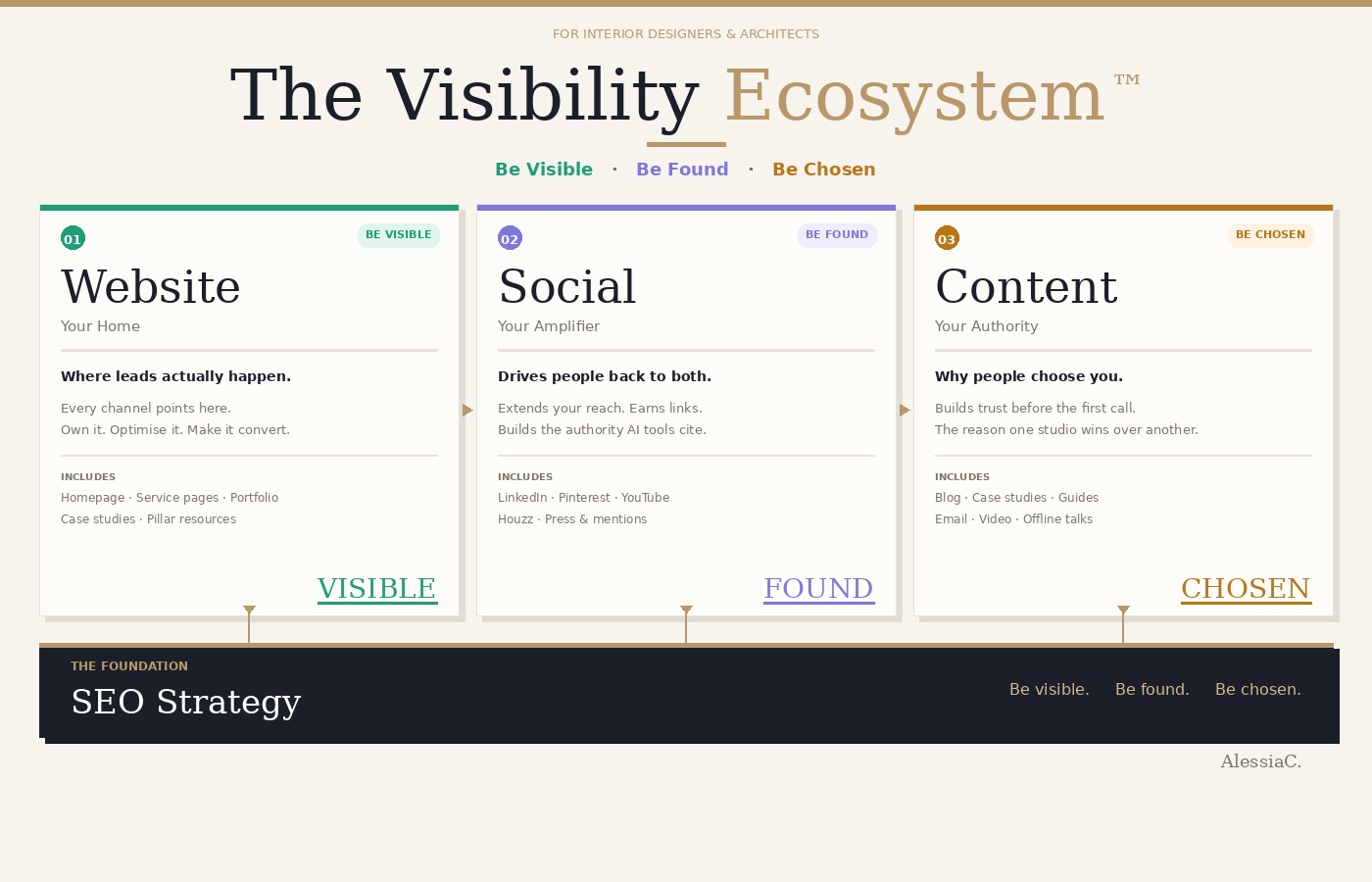
The Visibility Ecosystem™ is a proprietary framework developed by Alessia Civettini, built on one central principle: every element of your marketing should feed every other element.
It emerged from years of working with owner-led service businesses across different sectors — fertility consultants, psychotherapists, life coaches, and leadership coaches among them — before being refined specifically for the home and design industry. That breadth of experience, combined with a background in sustainable design furniture wholesale and a deep understanding of how creative studios actually operate, is what shaped the framework into what it is today. The Visibility Ecosystem™ is now applied exclusively to interior designers, architects, and home sector professionals: the businesses where Alessia’s strategic and industry knowledge run deepest.
It is not a checklist of tactics. It is a way of thinking about how your marketing activity connects — how a conversation at an industry event can drive someone to your website, how a website visit can become a blog reader, how a blog reader can become a client, and how that client can become a referral source who sends someone back to the beginning of the same journey.
The framework has three pillars, each corresponding to a stage in the client journey, and one foundation that makes all three possible.
The foundation is SEO strategy — the strategic work of understanding what your ideal clients are searching for and ensuring your studio is discoverable at every stage of their journey.
The three pillars map directly to AlessiaC’s core belief about what every design studio needs:
Be Visible — Website: your home. The one digital asset you fully own. Where leads actually happen. The destination every other channel points towards.
Be Found — Social: your amplifier. The channels that extend your reach, get your content seen by more of the right people, and drive them back to your home base.
Be Chosen — Content: your authority. The body of work — written, visual, spoken — that demonstrates your expertise and gives potential clients the reason to choose you over every other option.
There is a fifth element, often left out of digital marketing frameworks because it does not fit neatly into an online strategy. It belongs here.
Offline and experiential marketing — speaking, events, studio visits, press, community, networking — is not a relic of the pre-digital era. For many designers and architects, it remains the most natural and most effective lead generation channel available. The Visibility Ecosystem™ integrates offline activity as a first-class element, not an afterthought.
FREE Website Audit
The first step to better SEO is knowing what's working and what isn't. I offer a free website performance audit for interior designers and architects — a no-obligation review of your current site and SEO position, with specific recommendations you can act on immediately. This is a mini-version of my The Website Performance & SEO Audit Package
Claim your free website audit →The foundation: SEO strategy
Before building anything else, you need to know two things.
What are your ideal clients actually searching for? And where, in that search landscape, does a genuine opportunity exist for your studio?
This is what keyword research and competitor gap analysis answer. Not in abstract terms, but specifically: these are the searches your potential clients are making, these are the studios currently appearing for those searches, and here are the gaps where your studio can establish a presence that your competitors have not yet built.
These answers shape everything that follows. The pages your website needs. The topics your content covers. The way your social activity links back to your most important pages. The keywords in your LinkedIn profile and your Houzz listing.
SEO strategy is not a technical task to delegate after the rest of the strategy is built. It is the intelligence layer that informs every other decision. Done first, it makes every subsequent investment more effective. Done last — or not at all — it leaves the entire ecosystem built on guesswork.
For a complete breakdown of SEO strategy for design studios, from keyword research to GEO and AI search, see the Complete Guide to SEO and GEO for Interior Designers.
Be Visible: Website — your home
Your website is the only platform you fully own.
Social media platforms can limit your reach. Algorithms can change overnight. A LinkedIn account can be restricted. But your website, on your domain, with your content, is yours permanently.
Every element of The Visibility Ecosystem™ eventually points here. A Google search leads to your website. A Pinterest pin links to your website. A press feature drives traffic to your website. A referral checks your website before calling. Someone you met at an event goes home and searches your name.
This is where leads happen.
Which means your website has one fundamental job: when the right person arrives, make it unmistakably clear who you are, who you work with, and what to do next.
What makes a website generate leads
A website that is not generating enquiries is not necessarily a bad website. It may be a beautifully designed website that answers the wrong questions, targets the wrong visitor, or makes the journey to contact unclear.
The questions worth asking are straightforward. Does your homepage tell a visitor within five seconds who you are, what you do, and where you are based? Does every service have its own dedicated page, written with the words your clients actually search for? Does your portfolio do more than display images — does it tell the story of each project in a way that builds trust? Is there a clear, low-friction next step on every page?
If any of these are missing, the website is working against the ecosystem rather than anchoring it.
For a complete guide to website structure, page strategy, and conversion for design studios, see the Complete Guide to Website Strategy for Interior Designers.
Be Found: Social — your amplifier
Social media is the most misunderstood element in most designers’ marketing.
It is treated as a lead generation channel. It is not. It is an amplification channel. The distinction changes everything about how you use it and what you expect from it.
Social media does not replace your website, your content, or your SEO. It extends the reach of all three. It gets your blog posts read by people who were not searching for them. It keeps you visible to potential clients between their search activity. It builds the brand recognition that makes everything else more effective.
The right platforms for interior designers
Not all platforms contribute equally to your visibility. The ones that matter most for a design studio, in order of SEO and lead generation value, are:
LinkedIn for professional authority. Articles are indexed by Google directly. Consistent, expert posts reinforce your E-E-A-T signals and contribute to how AI search tools assess your credibility. Essential for building a professional reputation that extends beyond your immediate client base.
Pinterest for organic traffic. Pins are indexed by Google and drive referral traffic to your website for months after posting. A single pin linking to a well-written case study can generate steady clicks long after you have moved on to other things. Significantly underused by most design studios.
YouTube for project visibility. Owned by Google. Videos rank in search results directly. A project walkthrough published on YouTube reaches people searching on both YouTube and Google simultaneously. The highest-return platform for designers willing to invest in video.
Instagram for portfolio visibility and brand awareness. Limited SEO value — content is poorly indexed and links are not followed by Google. Valuable for building an audience and showcasing work, but not a lead generation engine on its own.
Houzz as a high-authority directory. A complete, keyword-rich Houzz profile earns a high-authority backlink to your website and can rank independently in Google results. Consistently overlooked and consistently undervalued.
The one rule that applies to every platform
Publish great content on your website first. Then share it across your social channels. Not the other way around.
Content that lives only on social media builds someone else’s platform. Content that lives on your website, distributed through social, builds yours.
→ Does Social Media Help You Rank on Google? The Honest Answer
Be Chosen: Content — your authority
Two designers. Similar portfolios. Similar pricing. Similar locations.
One has a homepage, a portfolio, and a contact page. The other has all of that, plus a body of content — blog posts, case studies, project pages, a resource guide — that answers the questions their ideal clients are asking.
A potential client visits both. On the first website, they see beautiful work. On the second, they see beautiful work and a clear signal: this designer understands clients, thinks carefully, and knows their subject deeply.
That signal is what content creates. And it is the reason someone chooses one studio over another when the portfolios are equally compelling.
What content actually does
It builds topical authority. Google treats websites that cover a subject thoroughly and consistently as more authoritative than those with sparse content. A studio with thirty well-structured posts on interior design topics tells Google: this is a genuine expert. That authority supports rankings across the entire site.
It answers questions before they are asked. Your ideal client has questions before they call. What does your process look like? What does it cost? What should they expect? Content that answers those questions builds trust before the first conversation. Clients who arrive having read your work are significantly more ready to hire than cold contacts.
It keeps you visible between searches. A blog post published today will continue to attract visitors for years. Unlike a social post that disappears within hours, well-optimised content compounds over time. The studio that starts publishing now will have a significant and growing advantage over the studio that starts in twelve months.
It feeds the rest of the ecosystem. Every piece of content you create is material for social posts, newsletter issues, podcast talking points, and event presentations. Content is not a channel that competes with the others. It is the fuel that powers all of them.
Starting a content strategy that is realistic
One well-written, properly optimised post every two weeks is enough to build meaningful topical authority over twelve months. Consistency matters more than volume. A post published fortnightly, indefinitely, outperforms ten posts published in a burst and then nothing for three months.
Start with the questions your ideal clients ask in every discovery call. Each one is a post. Answer it thoroughly, in plain language, with a clear structure. That is your content strategy.
→ [Content Strategy for Interior Designers: What to Write to Attract Clients COMING SOON
The fifth element: offline and experiential
Here is the element most digital marketing frameworks leave out entirely.
Offline marketing still works. For some designers and architects, it works better than any digital channel.
Speaking at an industry event in front of fifty potential clients is a lead generation activity. Hosting a studio visit or an open house is a lead generation activity. Being featured in a regional homes magazine is a lead generation activity. Having coffee with a property developer, an architect, or an interior stylist who shares your client base is a lead generation activity.
These are not relics of a pre-digital era. They are activities that build trust faster than any online channel, because they are human, in-person, and immediate.
The Visibility Ecosystem integrates offline activity deliberately because a marketing strategy should be built around the person running it, not around a digital playbook that assumes everyone thrives online.
The personal fit question
I will never ask a designer to go on social media if they are genuinely not confident there. An hour spent at an industry event, speaking to the right people, will generate more qualified leads for some studios than six months of Instagram posts.
The ecosystem framework is a set of interconnected elements. Not every element needs to be equally weighted for every studio. The right balance depends on where you are most natural, most confident, and most effective.
A designer who lights up in a room, who speaks well and loves conversation, should be on stages, at events, hosting gatherings, building a local and industry reputation through presence. Their digital channels amplify that offline authority.
A designer who writes beautifully but freezes on camera should build around written content and email, not video and Reels. Their offline activity might be intimate and one-to-one rather than stage-based.
The framework is the same. The weighting is personal.
How offline feeds the ecosystem
Offline activity does not exist in isolation from the digital ecosystem. It feeds it.
A speaking engagement generates content: a blog post summarising the talk, a LinkedIn article, a series of posts. It drives people to your website. It earns press mentions that create backlinks. It builds relationships that become referrals.
A press feature in a regional magazine drives branded searches — people searching your name directly on Google — which is a trust signal the algorithm responds to. It also creates a backlink from a credible publication, which strengthens your domain authority.
A networking relationship with a property developer or an architect does not just produce project referrals. It produces co-authored content, shared audiences, and the kind of third-party endorsement that AI search tools weight heavily when assessing your credibility.
Everything feeds everything.
FREE Website Audit
The first step to better SEO is knowing what's working and what isn't. I offer a free website performance audit for interior designers and architects — a no-obligation review of your current site and SEO position, with specific recommendations you can act on immediately. This is a mini-version of my The Website Performance & SEO Audit Package
Claim your free website audit →How the ecosystem feeds itself
The most important property of The Visibility Ecosystem is that each element strengthens the others over time.
Here is what that looks like in practice.
You publish a blog post answering a question your ideal clients frequently ask. It is well-structured, clearly written, and targets a specific keyword. Google indexes it and it begins to rank.
You share it on LinkedIn. A handful of people who were not searching for you read it. One of them is an architect who shares your client base. They save the post and follow your profile.
Someone else who reads it on Google subscribes to your newsletter. Over the following months, they receive your newsletter, return to read more posts, and form a clear impression of your expertise.
You speak at a local interiors event. Three people attend who have already read your blog. They come to the talk already warm. Afterwards, one books a discovery call.
The press coverage from the event drives a new wave of branded searches. Those searches signal credibility to Google. Your domain authority grows. Future posts rank more easily.
That architect who saved your LinkedIn post three months ago refers a client. That client found you on Google six months before the referral arrived, read four blog posts, and was already convinced.
No single element produced that client. Every element did.
This is why The Visibility Ecosystem™ is built around integration rather than optimisation of individual channels. Optimising Instagram in isolation produces Instagram results. Integrating every element into a coherent system produces compounding results.
Building your personal ecosystem
The framework is universal. The implementation is personal.
Before deciding which channels to invest in, which content to create, and which offline activities to prioritise, three questions are worth answering honestly.
Where are you most natural? Not where you feel you should be, but where you are genuinely comfortable and effective. Some designers are natural writers. Others are compelling in conversation. Others are visually brilliant but find words difficult. The ecosystem should be weighted towards your strengths, not built around your weaknesses.
Where are your ideal clients? Your ideal client’s discovery behaviour shapes your channel priorities. A designer targeting high-net-worth residential clients in London may find that press and events produce better results than LinkedIn. A designer targeting property developers may find the opposite. Understanding where your specific client spends their time and attention is more useful than following generic advice.
What does your business need right now? A studio in its first two years needs visibility above all else. An established studio with consistent referrals but flat enquiry volume may need to convert its existing visibility into a more deliberate content strategy. The right ecosystem for year one looks different from the right ecosystem for year five.
These answers produce a personalised version of The Visibility Ecosystem: the same interconnected structure, weighted and calibrated to the individual studio, its founder, and its stage of growth.
Where to start
The most common mistake when building a lead generation ecosystem is trying to activate all elements simultaneously.
The result is a studio doing everything at a shallow level and nothing at a depth that produces results.
A focused start is more effective. Begin with the foundation and the first pillar. Get the SEO strategy right. Then get the website working properly. Then introduce content, then social, then offline. Add each element when the previous one is functioning, not before.
In practice, for most solo studios, the right starting sequence is:
First: understand where you stand. Before optimising anything, know your current position. Which keywords is your site appearing for? Which pages are working? Which gaps exist in your content and structure? A structured website audit answers these questions and produces a prioritised action list.
Second: fix the website foundation. Ensure the structure is right, the pages that need to exist do exist, and the on-page SEO is in place. A well-structured, properly optimised website is the prerequisite for everything else.
Third: start content with a strategy. Identify the ten questions your ideal clients ask most frequently. Write one post per fortnight. Build the habit before increasing the volume.
Fourth: activate social as a distribution layer. Share every piece of content you publish. Engage with your professional community. Let social do the amplification job it is designed for.
Fifth: identify your strongest offline channel. One event, one press relationship, one industry connection. Start small and deliberately. Let the offline activity feed back into the digital ecosystem through content, coverage, and conversation.
The ecosystem builds. The compounding begins.
Ready to build your Lead Generation EcoSystem?
A free website performance audit is where most AlessiaC engagements begin. Not because the website is the only thing that matters, but because understanding where your current digital presence stands is the clearest starting point for building an ecosystem that works.
In 30 to 45 minutes you will have a clear picture of where you stand, where the gaps are, and what to prioritise first.
Claim your free website audit →This is a title
FAQ
Do I need to be on every social media platform?
No. The right platforms are the ones where your ideal clients spend time and where your strengths as a communicator are best expressed. For most interior designers, LinkedIn and Pinterest produce the strongest return for the investment. Instagram has value for portfolio visibility but limited lead generation value. Quality and consistency on two platforms outperforms a scattered presence across five.
How long does it take to build a functioning lead generation ecosystem?
The honest answer is twelve to eighteen months to see the full compounding effect of an integrated ecosystem. Individual elements produce results faster: a well-optimised website can start generating enquiries within weeks of launch, a blog post can rank within months, an event can produce enquiries the same day. The ecosystem value, where every element is feeding every other element, builds over time. Starting earlier always produces better results than waiting for the perfect moment.
What if I am not confident online but my business is performing well through referrals and offline activity?
Then your ecosystem is already partially built. The question is not whether to abandon what is working, but how to connect your existing offline activity to a digital presence that amplifies it. A designer who generates referrals but has no website that can support and convert those referrals is leaving significant value on the table. A press feature that drives searches for your name, which land on a well-structured website with compelling content, produces far more than a press feature that drives searches that find nothing worth staying for.
How do I know which offline activities are worth investing in?
The same way you evaluate any marketing activity: by asking where your ideal clients are, and where you are most effective. If your ideal client is a high-net-worth homeowner planning a renovation, the right offline activity might be press, local community events, and relationships with property developers. If your ideal client is a hospitality brand, it might be industry conferences and design trade shows. Start with one offline channel that aligns with both where your clients are and where you are genuinely comfortable. Build from there.
Is this framework only for interior designers?
The Visibility Ecosystem™ was developed by Alessia Civettini over years of working with owner-led service businesses across a range of sectors, including fertility consultants, psychotherapists, life coaches, and leadership coaches. The underlying principles — integration over isolation, ecosystem over individual channels, strategy aligned to the individual — were tested and refined across all of them.Today, Alessia applies The Visibility Ecosystem™ exclusively to interior designers, architects, and home sector professionals. That focus is a deliberate choice, not a limitation. It is where her strategic expertise, her background in sustainable design furniture wholesale, and her understanding of the creative industry converge. Every example, every application, and every recommendation in this guide reflects that depth of sector knowledge.The framework itself is universal. The implementation offered through AlessiaC is specific to the home and design world — which is precisely what makes it more effective for the studios it serves.
What is the difference between this and standard SEO advice?
Standard SEO advice optimises individual elements in isolation: improve your meta titles, build backlinks, post more content. The Visibility Ecosystem™ treats SEO as a foundation, not a tactic. It asks how your search strategy connects to your website, your content, your social presence, and your offline activity, and how all of those elements can be integrated into a system where each one makes the others more effective. The goal is not better rankings. The goal is a business that attracts the right clients consistently, regardless of which channel they arrive through.
About the Author
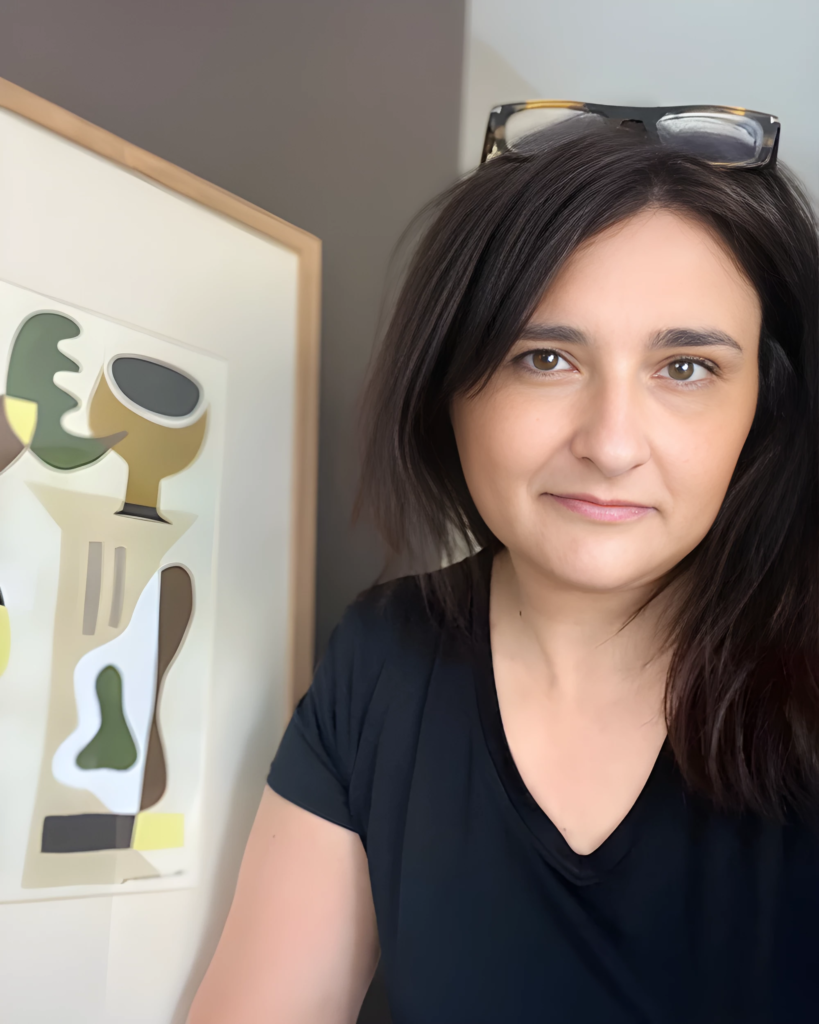
Alessia Civettini is a fractional SEO consultant and website strategist with over five years’ experience specialising in interior designers and architects. She helps solo practitioners and small studios build a powerful online presence — from website strategy to SEO, GEO, and AI-powered search.
In a field evolving faster than any other in digital marketing, Alessia is in constant professional development — staying at the forefront of
AI search, generative engine optimisation, and the signals that matter most right now. Her clients get strategy that reflects today’s search
landscape, not last year’s best practice.