

Someone slid into my DMs recently with a question I get more often than you might expect."Does posting on social media help you rank higher on Google?"It is a great question. And the answer is more interesting than a simple yes or no.
This post is part of the Complete Guide to SEO and GEO for Interior Designers and Architects, covering everything you need to know about search visibility in one place.
The short answer
Social media does not directly affect your Google ranking. Google has been consistent on this for years. Likes, shares, followers, and engagement are not direct ranking factors. Your Instagram following has no bearing on your position in search results. But here is where it gets interesting.
The indirect effects of a smart social media strategy on your SEO are real, meaningful, and often underestimated.
Understanding the difference between direct and indirect is what separates a social media strategy that simply gets likes from one that quietly builds your search visibility over time.
The Indirect SEO Power of Social Media (5 Ways It Works)
1) It earns backlinks
Backlinks, links from other websites pointing to yours, are one of Google's most significant ranking factors.
The more credible websites that link to your content, the more authority Google assigns to your site.Social media is a distribution engine for content that earns those links.
Every time a blog post, case study, or project page gets shared widely on LinkedIn, Pinterest, or elsewhere, it increases the chance that a journalist, blogger, or industry website owner sees it and links to it.
According to an analysis by NP Digital, websites that incorporate content marketing such as blogs and podcasts experience 75.29% more organic traffic, 48.43% more backlinks, and 8.16% higher conversion rates. Campaign Asia
The content does not earn the link by being on social media. It earns the link because social media got it in front of the right person.
2) It speeds up indexing
When a piece of content generates social activity, Google's crawlers follow the interest. A new blog post shared on LinkedIn and saved on Pinterest gets crawled and indexed significantly faster than one sitting quietly on your website with no promotion. Getting indexed quickly matters, particularly for time-sensitive content or posts targeting trending searches.
3) It builds branded search volume
A consistent, expert social media presence increases the number of people who search for your name directly on Google.Branded search volume, how often people search for "Alessia Civettini" or "AlessiaC SEO," is a trust signal Google pays close attention to.
A studio that people seek out by name carries more authority than one that is only discovered through generic searches. Social media builds name recognition, and name recognition drives branded search.
4) It drives traffic that improves engagement signals
A post shared on LinkedIn or Pinterest that drives visitors to your website creates behavioural signals Google uses to assess quality: time on page, pages visited per session, return visits. None of these are direct ranking factors in isolation, but collectively they paint a picture of a website that people find genuinely useful. That picture matters.
5) It reinforces your E-E-A-T signals
E-E-A-T stands for Experience, Expertise, Authoritativeness and Trustworthiness. It is the framework Google uses to assess the credibility of the person behind the content, not just the content itself.
An active LinkedIn presence with consistent, expert posts about SEO, GEO, and website strategy for designers sends a clear signal: this is a real specialist with genuine expertise and a professional reputation.
That signal supports your rankings, particularly for competitive keywords where Google is deciding between several credible options.
Not all platforms are equal for SEO
Different platforms contribute to your search visibility in very different ways. Here is an honest breakdown.
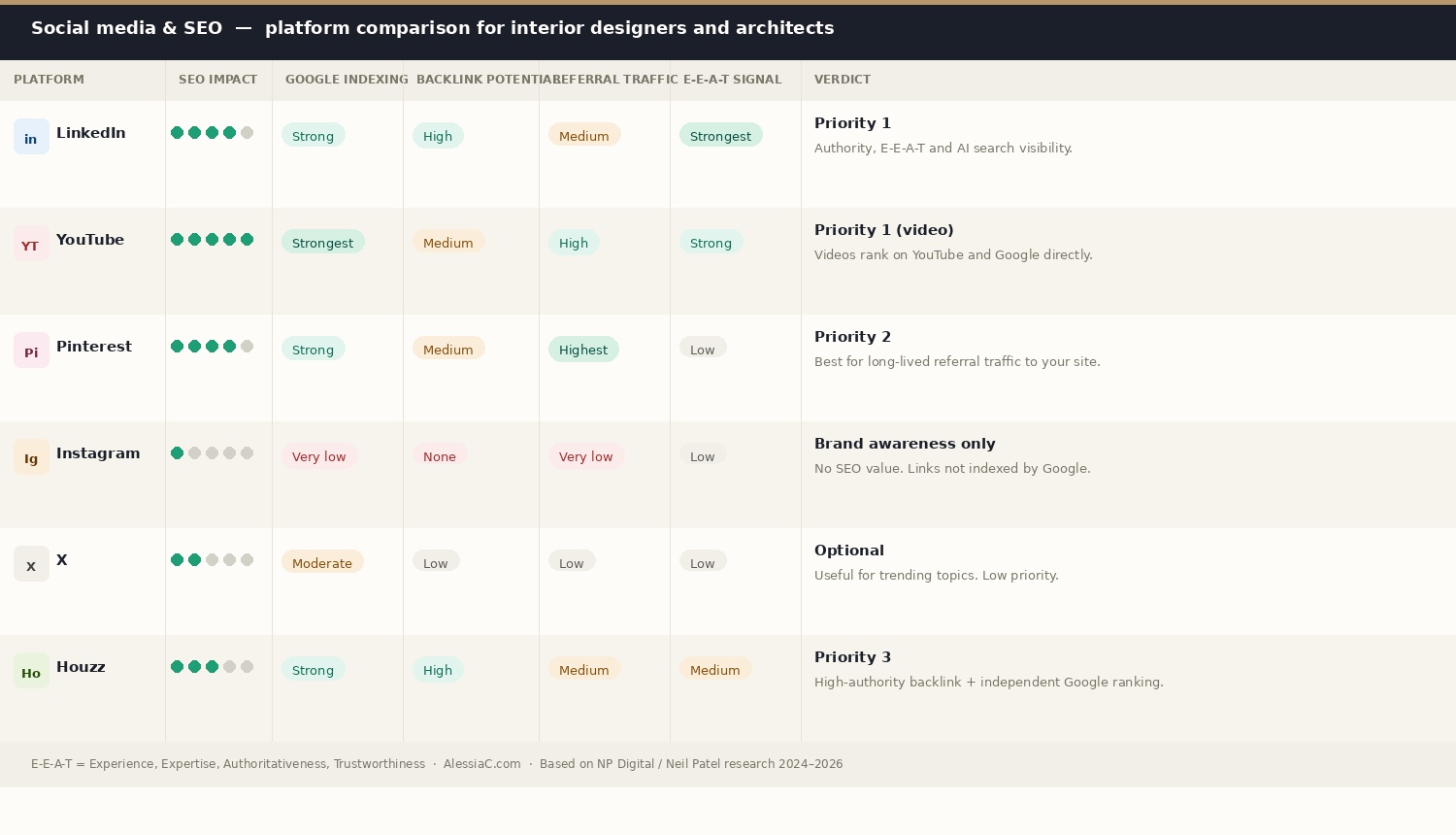
LinkedIn articles are indexed by Google directly. A well-written LinkedIn article targeting a relevant keyword can appear in search results independently of your website. For a B2B personal brand like AlessiaC, LinkedIn is also the strongest platform for reinforcing E-E-A-T signals and building the professional authority that AI tools draw on when assessing credibility.
YouTube is owned by Google. Videos rank in search results directly, often appearing above organic text results. A well-titled project walkthrough or how-to video can drive search traffic from both YouTube and Google simultaneously. For interior designers with video content, this is the highest-return platform for SEO purposes.
Pinterest is a visual search engine in its own right. Pins are indexed by Google and can drive significant organic traffic long after they are posted. A pin saved today can still be generating clicks to your website six months later. For design studios with strong visual content, Pinterest is significantly underused and consistently undervalued as an SEO asset.
X (formerly Twitter) posts are indexed by Google and are particularly useful for trending and news-adjacent topics. Less relevant for a design studio than the platforms above, but worth maintaining a presence for indexed content.Instagram offers very limited direct SEO value. Content is not well indexed by Google, and links in posts are not followed. Its value for interior designers lies in brand awareness and audience building rather than search visibility.
The platform worth most of your attention
If you are a solo interior design studio and want to know where to focus for SEO impact, the answer is two platforms.
LinkedIn for authority and indexing. Consistent, expert posts establish your professional credibility, support your E-E-A-T signals, and give Google an additional indexed presence for your name and expertise. Articles in particular can rank independently.
Pinterest for organic traffic. Pins live for months and drive consistent clicks to your website long after posting. A pin linking to a case study, a blog post, or a project page is a long-lived traffic source that most design studios leave entirely untapped.Both are underused by most design studios. Both offer a meaningful return for relatively modest effort when used strategically.
The practical strategy that connects it all
Social media and SEO work best when they are part of the same strategy, not two separate ones.
The sequence that produces the strongest results is straightforward.
Publish great content on your website first. A blog post, a case study, a project page, a resource guide. Something genuinely useful, properly optimised for search, and worth sharing.
I always suggest to my clients that they start with long-form content. Then they can break it into small nuggets for social media.
On average, a medium-length blog post can become three Instagram posts and two LinkedIn posts.
Then distribute it through social channels the same day. Not for the likes. For faster indexing, for a better chance someone links to it, and for traffic back to your site. One without the other is only half a strategy.
Content on your website with no social distribution reaches a smaller audience and indexes more slowly.
Social content with no website destination behind it builds engagement but no lasting search equity.
The strongest results come when both work together: great content published on your website, then amplified through the platforms where your audience actually spends time.
In other words, your LinkedIn posts will not rank you. But they might just reach the person who links to the page that does.
What this means for AI search
There is one more layer worth understanding in 2026.
AI search tools including ChatGPT, Perplexity, and Google AI Overviews do not only read your website when deciding whether to cite you.
They synthesise information from across the web: your website, your LinkedIn profile, press mentions, directory listings, and your broader digital presence.A consistent, expert-positioned LinkedIn presence contributes to the picture these tools build of who you are and how credible your expertise is.
It is not about individual posts going viral. It is about the cumulative signal that emerges when your name, your specialism, and your expertise appear consistently across multiple credible sources.
This is one of the reasons why social media strategy and GEO strategy are more closely connected than most designers realise. Your LinkedIn is not just a networking tool. It is part of the evidence base that AI tools draw on when deciding whether to recommend you.
The bottom line
Social media will not replace technical SEO, quality content, or backlinks as the foundations of your search visibility.But a smart social strategy, focused on the right platforms, used to distribute genuinely useful content from your website, amplifies everything you are already doing
For interior designers and architects investing in their online presence, the question is not social media or SEO. It is how to make both work together so that each one makes the other more effective.
Your work speaks for itself. The job is to make sure the right people can find it.